Showing posts with label JPL HD Mars Images. Show all posts

Friday, April 25, 2014

Lost in Space - April 25th, 2014

Welcome back My Dear Readers to The Other Shoe. Today I would like to welcome you to another fine edition of the space faring series ‘Lost in Space’! I have some pretty spectacular images, again, from the space telescope Hubble. As well, with each image I will do my best to share information about location, and what it is that we are looking at. However, before we get started today I would like to as just how many of you, My Dear Readers, have taken the plunge?

.

The plunge into the horror series, right here at The Other Shoe, ‘The Horror in Smithville’. We are now in our SEVENTH week of this terribly entertaining, and suspenseful, serial horror story. In just a matter of a couple of months this horror series has captured the hearts, and minds, of hundreds of readers. Join us, each and every Thursday, as Timmy and Archer; battle zombie-wolves, stare down ‘The Tall Man’ and take on everything my imagination can throw at them. This run away favorite of you, My Dear Readers, is just getting started. Isn’t it about time that you made a little time, each Thursday, for this incredibly popular and suspenseful horror series?

.

Now that we are through with the commercial break, let’s get back to the stars! As with every week I have a batch of incredible images from the Hubble space telescope. Our very first image, for this week’s edition, comes from the El Goro Galaxy Cluster[1]. ‘El Goro’ is Spanish for ‘The Fat One’ and this galaxy cluster lives up to that name. Only a mere 9.7 billion light years from Earth, this cluster has a mass nearly 3 billion times that of our sun, Sol. The immense size of this galaxy cluster was first reported in January 2012 by scientists at NASA's Chandra X-ray Observatory. I picked this image because it reminded me of something I saw as a young boy. 

.

[caption id="attachment_2784" align="aligncenter" width="630"]NASA Hubble Team Finds Monster El Gordo Galaxy Cluster Bigger Than Thought NASA Hubble Team Finds Monster El Gordo Galaxy Cluster Bigger Than Thought[/caption]

(NASA Hubble Team Finds Monster El Gordo Galaxy Cluster Bigger Than Thought)


.

Our next image comes from the constellation Leo and is of the galaxy known as NGC 3455[2]. The image is of a barred spiral galaxy roughly 65 million light years from earth. It was discovered, and this image was taken, April 14th, 2014. There you go, My Dear Readers, I am keeping you abreast of the newest news in the Hubble discovery universe! Finally, here is a little of the science behind the image, straight from NASA’s web site; “Barred spiral galaxies account for approximately two thirds of all spirals. Galaxies of this type appear to have a bar of stars slicing through the bulge of stars at their center. The SB classification is further sub-divided by the appearance of a galaxy's pinwheeling spiral arms; SBa types have more tightly wound arms, whereas SBc types have looser ones. SBb types, such as NGC 3455, lie in between.”[3]

.

[caption id="attachment_2781" align="aligncenter" width="630"]Hubble Sees Galaxies Spiraling around Leo Hubble Sees Galaxies Spiraling around Leo[/caption]

(Hubble Sees Galaxies Spiraling around Leo)


.

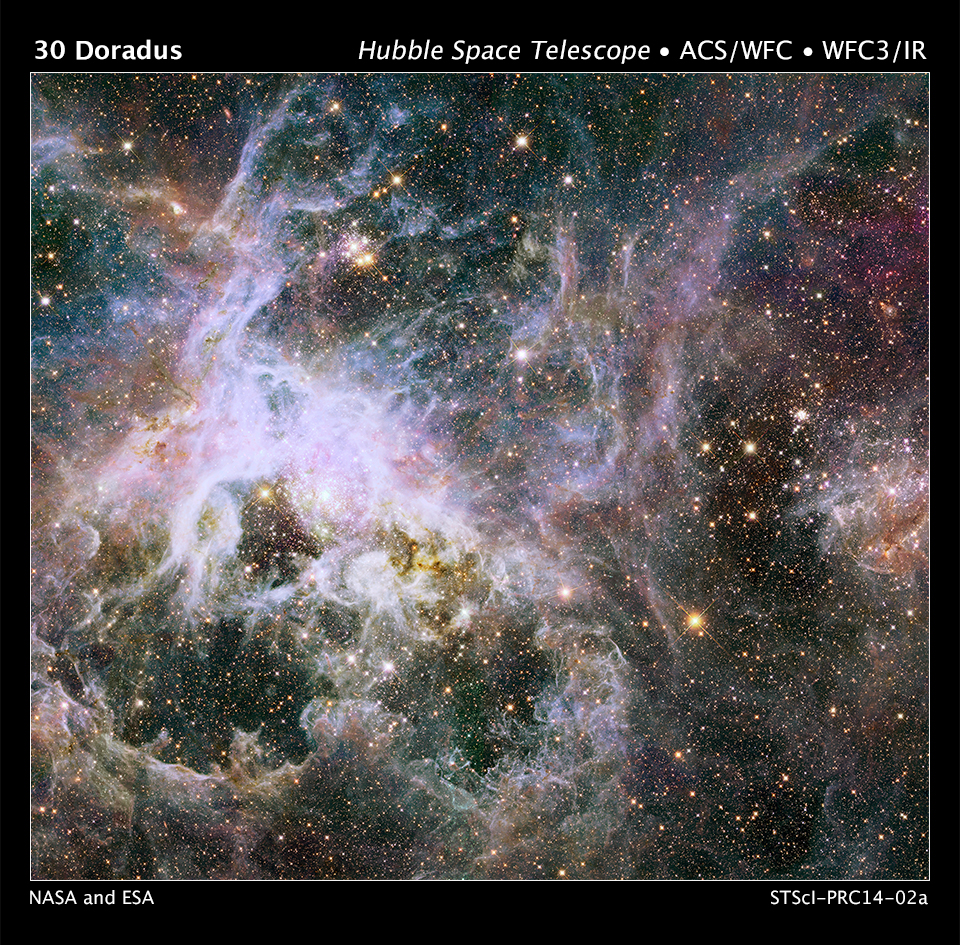
Moving right along, My Dear Readers, our next stop is in the Tarantula Nebula[4] (also known as 30 Doradus, or NGC 2070). A mere 160,000 light years from earth, a walk in the park by Hubble standards, this nursery for the stars contains (roughly) 800,000 stars in various stages of formation. You just gotta love those nebula! So much science is contained in a nebula like the Tarantula that Hubble has created the Hubble Tarantula Treasury Program’[5] to gather and catalog it all. Now, on with the iamge!

.

[caption id="attachment_2780" align="aligncenter" width="630"]Hubble Probes Interior of Tarantula Nebula Hubble Probes Interior of Tarantula Nebula[/caption]

(Hubble Probes Interior of Tarantula Nebula)


.

Let’s keep moving, My Dear Readers, there is another tour group hot on our heels! The next image is brought to us by Messier 83[6]. A big favorite of armature astronomers (there is even a rock band named M83…). A mere 15 million light years away, in the constellation of Hydra[7] this wondrous sight is also known as ‘The Southern Pinwheel’. At roughly 50,000 light years across thisbarred spiral galaxy is home tohundreds of thousands of stars, Ghosts of dead stars called supernova remnants, and stars in all different states of life.

.

[caption id="attachment_2782" align="aligncenter" width="630"]Hubble Views Stellar Genesis in the Southern Pinwheel Hubble Views Stellar Genesis in the Southern Pinwheel[/caption]

(Hubble Views Stellar Genesis in the Southern Pinwheel)


.

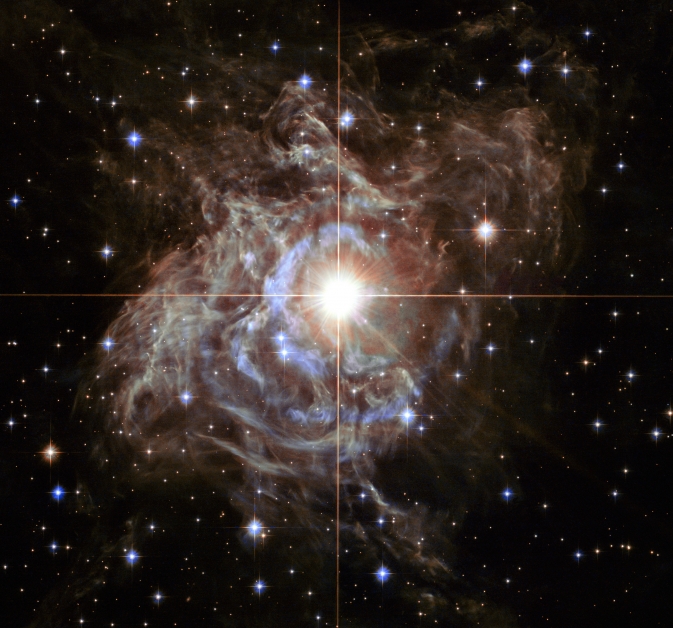
Moving right along… let’s pick up the pace, back there at the end of the tour line… we don’t have all day, we have an absolutely fantastic image. This image is reminiscent of a Holiday Wreath, with the center of the wreath the brightest star RC Puppis[8]. RC Puppis is a Cepheid variable star in the constellation of Puppis. This star pulsates in a six week cycle where it will dim, then build up the luminosity we see in the image below. At its highest point of luminosity it is 15,000 times brighter than our sun, Sol.

.

[caption id="attachment_2783" align="aligncenter" width="630"]Hubble Watches Super Star Create Holiday Light Show Hubble Watches Super Star Create Holiday Light Show[/caption]

(Hubble Watches Super Star Create Holiday Light Show)


.

Our final image, for the day, comes to us from the galaxy ESO 137-001[9]. Another barred spiral galaxy it is located in the start cluster known as Abell 3627[10] (also known as Norma Cluster). This image is of a cluster of galaxies roughly 200 million light years from earth. The Norma Cluster appears zooming to the upper right of this image. Yes, it is the ghost-like spiral blue near the top right of the image. As a special treat just below the static image, just for you My Dear Readers, is a video from NASA/JPL just about this image and the heading. ENJOY!

.

[caption id="attachment_2786" align="aligncenter" width="630"]NASA's Hubble Finds Life is Too Fast, Too Furious for This Runaway Galaxy NASA's Hubble Finds Life is Too Fast, Too Furious for This Runaway Galaxy[/caption]


(NASA's Hubble Finds Life is Too Fast, Too Furious for This Runaway Galaxy)


.


[youtube=http://youtu.be/Y0gamjjr45Q]


.

Well, My Dear Readers, that brings us to the end of another great edition of ‘Lost in Space’ right here at The Other Shoe. I hope that everyone has enjoyed the wonderful images. As well, I want you to be aware that there is a huge amount of science contained in these articles. Just follow any of the nine links (at the bottom of the article) to the accompanying articles about the galaxies and nebula contained within this article.

.

Yes, I do go the extra mile for you, My Dear Readers. I really wish that I had a telescope… and lived in a place where all the stars are wiped clean from the sky by background light pollution. Yes, for the past twenty-seven years I have lived in the Los Angeles basin. Once there, all the stars in the sky are wiped clean and replaced with, airplanes and helicopters. I remember my first week here, living in Hollywood, I just couldn’t sleep at all because of the constant noise of police helicopters and the irritating background light pollution. Again, enjoy this trip through the heavens, this walk among the stars, brought to you by Yours Truly each and every week, right here at The Other Shoe.

.

Adieu!

.

Thank YOU!
.


[caption id="" align="aligncenter" width="234"]The Other Shoe eBay Store The Other Shoe eBay Store[/caption]

www.ebay.com/usr/enzomatrixlt


.


[caption id="attachment_2296" align="aligncenter" width="630"]The Other Shoe's Daniel Hanning The Other Shoe's Daniel Hanning 2/2014[/caption]


Tuesday, April 15, 2014

Lost in Space - April 16th 2014

[caption id="attachment_2725" align="aligncenter" width="630"]Galaxy M106 Galaxy M106[/caption]

(Galaxy M106)


.


Welcome back My Dear Readers to The Other Shoe, and welcome to this week’s edition of ‘Lost in Space’. As with every week, I have already picked out the images for your viewing pleasure. Boy, do I have a great batch of stellar eye-candy for you to view. Just like every other week, I have also done a bit of research for each image I present. Having said, I simply must tell you, My Dear Readers, that the universe around us is a wondrous place filled with amazing sights and incredible science.


.

I do hope that I never loose a sense of wonder and that neither do you, My Dear Readers, too. If you ever feel that a day or a week, or a single horrible event has just sucked all the joy from life? Find a very dark place, far from all the lights of the city and industry. Find a clean dry place to lie on your back, and wait for the sun to set. Once set, you will be overwhelmed by the beauty and wonder held in the stars.

.

My Dear Readers, I was raised in Southeast Texas; first Houston then a small’ish town named Pearland. I was quite fortunate that, if I rode my bike for about an hour, I could find myself far removed from all sources of background light. It was on just such an adventure that, for the first time, I saw the Milky Way galaxy on edge. We live on one of the spiral arms of the Milky Way galaxy, However, ever so often you can catch a glimpse of our own galaxy from the inside out. Countless stars… literally so many stars that it is impossible to count.

.

It was while I was living in Colorado Springs, that for the very first time in my life I was witness to fields of stars. There were the brightest stars, in the foreground of the sky. Then, not as bright but far more in number, I could see the next field of stars. They spread from horizon to horizon all around me and in many colors they sparkled and gleamed. Then, behind the other two fields of stars, I saw a third field of stars. It was then that I realized that I was privy to a sight… a precious and wondrous sight. I bore witness to a band of stars that make up our home galaxy, The Milky Way.

.

Only in places, like up high on Pike’s Peak I saw field after field of stars. I saw… bore witness to stars of all colors, all sizes and all shapes. I did this all with my naked eyes, and I never wanted the sun to rise again. My Dear Readers, once you see our universe and all the stars that make up a clear, and background light pollution free, sky you understand. Understand the wonder that drove mankind to venture; first off of the European continent and later off of our home planet, Earth. I fell in-love with all things ‘space’.

.

My Dear Readers, it has been more than thirty-five years since I have seen stars in fields behind fields, behind fields. Many nights I fall asleep with fear in my heart (one, that I won’t wake up the next day) that I will never see stars like that, again. It may well seem a poor substitute, the images I share here in ‘Lost in Space’ and ‘The Mars Report’. It may well, be just that, but… it ‘keeps the deep longing at bay’. I pray that some day I will be able to look up at a night sky and see stars two or three fields deep. I hope, when/if that day comes that I have a very good camera with me, so that I might capture some of that wonder and share it with you, My Dear Readers. Now, without further adieu, I bring you this week’s ‘Lost in Space’!

.

The very first image I have to present to you, today, is of DEM L 190.[1] AKA N 49 this remnant from a massive star is a close neighbor to our own Milky Way. The fibers of star-remnant came to life in the barely imaginable explosion or this dying star, in a supernova. Amazing that such a horrific and massive (barely comprehendible by humans) can result in an image that captures beauty and wonder. Blues, reds, yellows and white strands all intertwined, threaded, in a shape that might well be imagined as a serving of ‘Galactic Cotton Candy’ void of a wrapper to serve. As if made my the hand of God himself, just for a reminder that in a world gripped in; poverty, strife, political unrest and hunger there can still be beauty. If we look long enough, hard enough, and past the borders of our own solar system.

.

[caption id="attachment_2724" align="aligncenter" width="630"]DEM L 190 DEM L 190[/caption]

(DEM L 190)


.

Known as ‘M 51’ or ‘Messier 51’[2] for its discoverer this whirlpool galaxy, and its companion (M51B), are one of the most known and popular galaxies among professional astronomers and amateur astronomers alike. This image, captured by the Hubble Space telescope, are (likely) wallpaper to millions of computer desktops around the world. If you look closely, at this image, you can see the spiral arm, at the top of the image, is being pulled into the companion galaxy. The spiral arm of M51, being too far from the center of the home galaxy, drawn in by the greater gravitational force coming from the companion galaxy.

.

[caption id="attachment_2729" align="aligncenter" width="630"]Whirlpool Galaxy (M51) and Companion Galaxy Whirlpool Galaxy (M51) and Companion Galaxy[/caption]

(Whirlpool Galaxy (M51) and Companion Galaxy)


.

I might have mentioned this, in one of the earlier editions of ‘Lost in Space’ but all the images I share are from the Hubble Space Telescope. The Hubble is the single greatest human achievement, in the field of telescopic sight. In, just, the twenty-four years since its launch into orbit the Hubble has given mankind more and better images of deep space than in the previous thousand. I think mankind should endeavor to put space telescopes; on the Moon, Mars and Io (a moon of Saturn). We are learning so much, every day, from the images from Hubble and the Martian rover Curiosity. They more than pay for themselves.

.

The next image for our stellar trek, today, comes from a nebula with a very subdued name ‘The Butterfly Nebula’[3][aka NGC 6302]. The ‘Butterfly Nebula’ is anything but subdued or dolce. The center star of this nebula is a ‘White Dwarf’ and only discovered in 2009. Known of since 1888, drawn and described in 1907 by Edward Emerson Barnard this gaseous nebula looks more like a graphics for a modern day science fiction movie than a nursery for the stars. The outgases, that make up the brilliant blue and red lobes of this nebula are actually stellar debris and gasses moving at 600,000 miles per hour.

.

[caption id="attachment_2732" align="aligncenter" width="630"]Butterfly Emerges from Stellar Demise in Planetary Nebula NGC 6302 Butterfly Emerges from Stellar Demise in Planetary Nebula NGC 6302[/caption]

(Butterfly Emerges from Stellar Demise in Planetary Nebula NGC 6302)


.

Our next image, and member of our galactic neighborhood, is a mere 1,500 light years from our solar system. What makes the following image distinct is that it is the “single sharpest image ever” of… … … (drum roll please)… The Orion Nebula[4]. Yes, even the ‘lay’est’ of laymen has heard of the Orion Nebula. There are more pictures/images of this particular nebula than (I believe) any other nebula in the Milky Way. The Orion is a textbook nebula with more than 3,000 stars of various sizes and stages of development. The study of just this one nebula can give mankind more understanding of the life, death and development of stars than any other single place in the known universe. That is why this incredibly sharp image, taken by Advanced Camera for Surveys (ACS) aboard NASA's Hubble Space Telescope, is so very important to astrophysicists and scientists alike.

.

[caption id="attachment_2727" align="aligncenter" width="630"]Hubble's Sharpest View of the Orion Nebula Hubble's Sharpest View of the Orion Nebula[/caption]

(Hubble's Sharpest View of the Orion Nebula)


.

Boy, it seems as if I am on quite a roll, here today, in presenting better and more impressive images one after another. So impressed, I am, with the visuals of this nebula I have elected to include two images in this edition. Two images, in one edition, is unheard of in the month that I have published this stellar series. As I was saying the Orion Nebula has 3,000+ stars in all sizes, all stages of development and gives mankind a very unique opportunity. A unique opportunity to study thousands of; births, life-spans and deaths of stars all in one place. Further, being in the same nebula the same quadrant of space and under the same gravitational influences, it creates a laboratory like environment for astrophysicists and scientists of all disciplines. However, I am just struck by its beauty, and depth of visual spectacle.

.

The subject of the next two images is the Carina Nebula[5]. The first of the next two images (both of Carina Nebula) is a Fifty Light Year View of this nebula. That makes this (top of the two) image the single LARGEST IMAGE EVER taken by the Hubble Space telescope. That is a huge (pardon the pun) achievement for NASA/JPL and mankind. As well, with the Carina Nebula we have a unique opportunity to observe a stellar nursery at the very dense arm of a spiral galaxy. The Carina Nebula is giving birth to a spiral galaxy identical to our own, the Milky Way galaxy. Witnessing this birth, is like witnessing the birth of our own sun Sol. Our own solar system and perhaps even our own planet Earth! Please take a close look at the following two images as they could well reveal the very creation of another Earth. I hope you enjoy these two images as much as I do.

.

[caption id="attachment_2728" align="aligncenter" width="630"]The Carina Nebula Star Birth in the Extreme The Carina Nebula Star Birth in the Extreme[/caption]

(The Carina Nebula Star Birth in the Extreme)


&


[caption id="attachment_2733" align="aligncenter" width="630"]Carina Nebula Carina Nebula[/caption]

(Carina Nebula)


.

Now, for out very last image for this edition of ‘Lost in Space’. Not leaving the Carina Nebula I wanted to share another brilliant image. This image shows an image of a stellar jet in the Carina nebula. The image was taken ultraviolet/visible light and is terribly revealing and educational. This image, taken with the Wide Field Imaging Camera and the Ultraviolet Imaging Spectrograph aboard the Hubble space telescope, shows us an aspect of the life-span of a star mankind had never seen previously. See, I hadn’t even arrived at this point in the research, when I stated as much, in the paragraph above. Honestly, the way I research and upload/download these images just keeps me guessing up to the moment I press ‘Publish’. 

.

[caption id="attachment_2726" align="aligncenter" width="630"]Hubble WFC3 image of a stellar jet in Carina Hubble WFC3 image of a stellar jet in Carina[/caption]

(Hubble WFC3 image of a stellar jet in Carina)


.


Well, My Dear Readers, that brings us to the very end of this week’s edition of ‘Lost in Space’. I really do hope that you have enjoyed this article just as much as I have enjoyed; picking out the images, researching the galaxies and stars, downloading the images to my computer, uploading them to my blog(s) [both] and integrating the images and the narrative I have written. Yes, it is a lot of work. Both ‘Lost in Space’ and ‘The Mars Report’ have the exact same construction, writing, editing and publication processes.

.

It is all worth it to me to enlighten and entertain you, My Dear Readers. You see I LOVE the stars. Everything about stars and galaxies and nebula, and all the science that goes into their study, brings a smile to my face and a warmth to my heart. I simply love sharing, what I can, of space and the stars with you, My Dear Readers. So, when all is said and done this is a joy for me, and I hope it brings joy to you!

.

Now, if I may… and I do apologize if this is ‘Bad Form’. If you would please take a moment and press the ‘Like’ button just below the bottom of this article. That way I know that I am reaching people, that this series of articles is a success and I can pass this information along. I would very much appreciate your ‘Likes’.

.

As well, if you are on Facebook and see this promoted there? Would you Please consider… ‘Sharing’ this edition of ‘Lost in Space’ with your friends? I understand that is asking a lot… but I really do believe that your friends will likely enjoy this article, the images from space and the science and information just as much as you, My Dear Readers. Thank you for your time and consideration regardless of your choice. My Dear Readers, it is you that I get up for every single morning.

.

Thank you for coming by, and thank you for all your time and efforts.

.

Adieu!

.

Thank YOU!


.

[caption id="" align="aligncenter" width="234"]The Other Shoe eBay Store The Other Shoe eBay Store[/caption]

www.ebay.com/usr/enzomatrixlt


.


[caption id="attachment_2296" align="aligncenter" width="630"]The Other Shoe's Daniel Hanning The Other Shoe's Daniel Hanning 2/2014[/caption]


Sunday, April 6, 2014

The Mars Report - April 7th, 2014

[caption id="attachment_2676" align="aligncenter" width="630"]Martian Northern Hemisphere & North Pole Martian Northern Hemisphere & North Pole[/caption]

.

Welcome back My Dear Readers to The Other Shoe. I hope that everyone is having a Good Monday, a great start for a wonderful week. I am most pleased to announce that I have a rather nice batch of images, from Mars, to share with you today. Now, I will be the first to admit, they are not as stellar (did you get that?) as my offerings last week. Our intrepid adventurer the rover, Curiosity, has made progress and has arrived at the next waypoint, the Kimberly.

.

Ok, I kind of got things bass-ackwards. Let me tell you about the image above. This article opened with an spectacular image of the northern hemisphere of Mars, showing the Martian North Pole. My Dear Readers, until the 14th of this month, you can get a better look at Mars than anytime since 2008. For, you see, Mars is only 56 million miles from Earth for the next week. That is less than 1/5 of the greatest distance Mars travels away from us, at 256 million miles.

.

You see, My Dear Readers, Mars has always held a special fascination for me. Even as a boy, looking through a telescope I made with paper towel cardboard tubes and lenses from a broken pair of binoculars, I would spend hours looking up at the Martian surface. Granted I could not make out more than patches of dark and, in the spring, the glow of the northern pole. This great red orb in the sky fascinated a young Danny. I had always hoped to own a better telescope.

.

Now, I spend hours upon hours viewing images at NASA and JPL. Devouring all that I can read, see and glean Mars still captures my fascination and imagination. You now know my reason for ‘The Mars Report’, eh? Having said, let’s get started with today’s images, and the stories they tell.

.

As I mentioned, above, Curiosity’s next waypoint is the Kimberly. Our next image, for today, is from Curiosity’s ‘NavCam’ (Navigational Camera) on the 588th Martian day, or Sol day. This position was picked as a vantage point for extensive viewing of the various rock types. In the background, the horizon of this image, are the primary science destinations for this mission. The lower slope of Mount Sharp. In the coming weeks, and months, watch with me as this destination gets closer and closer.

.

[caption id="attachment_2673" align="aligncenter" width="630"]Curiosity's View From Before Final Approach to 'The Kimberley' Waypoint Curiosity's View From Before Final Approach to 'The Kimberley' Waypoint[/caption]

.

In our last edition of ‘The Mars Report’ I shared a map showing the journey, so far. Today I have a similar offering, for our next image. The image below was taken by the High Resolution Imaging Science Experiment (HiRISE) camera aboard NASA's Mars Reconnaissance Orbiter. There were two images, to choose from, showing this path. One was in black and white, the other was in color. I picked the color image for today’s publication. So, here is a nice splash of color for your enjoyment.

.

[caption id="attachment_2675" align="aligncenter" width="630"]Map of Curiosity Mars Rover's Drives to 'the Kimberley' Waypoint Map of Curiosity Mars Rover's Drives to 'the Kimberley' Waypoint[/caption]

.

Oh, what the heck, I looked at the black and white image and it shows a lot more of the journey Curiosity has made so far. Therefore, below is a large image from the High Resolution Imaging Science Experiment (HiRISE) camera on NASA's Mars Reconnaissance Orbiter. Showing several of the pervious waypoints, this image gives us a better idea of just how far our intrepid rover, Curiosity, has driven.

.

[caption id="attachment_2671" align="aligncenter" width="630"]Curiosity Mars Rover's Route from Landing to 'The Kimberley' Waypoint Curiosity Mars Rover's Route from Landing to 'The Kimberley' Waypoint[/caption]

.

The next to the last image, for today’s edition of ‘The Mars report’ I give you ‘The Kimberly’ waypoint. This image was taken on Martian Day number 589, April 2nd, 2014. Taken by Curiosity’s navigational camera (NavCam) shortly after arrival this image marks a major accomplishment. The center of the image shows an outcrop called "striated" by the project scientists.

.

[caption id="attachment_2672" align="aligncenter" width="630"]Curiosity's View From Arrival Point at 'The Kimberley' Waypoint Curiosity's View From Arrival Point at 'The Kimberley' Waypoint[/caption]

.


The final image… well, I have saved the very best image for the very last image. Taken from the Mars Reconnaissance Orbiter this spectacular image is of a recently made crater in the Martian surface. The very center of this crater measures 100 feet in diameter (30 meters) and appears blue in this image. The bluish color is due to the fact that all the red soil, customary to the Martian surface, was ejected on impact. The explosion created the blast area seen around the center crater. This blast zone is several miles in diameter, and the blast threw ejecta (the term used for displaced soil in a crater) as far as 9.3 miles.

.

[caption id="attachment_2670" align="aligncenter" width="630"]A Spectacular New Martian Impact Crater A Spectacular New Martian Impact Crater[/caption]

.

That brings us, My Dear Readers, to the conclusion of this week’s edition of ‘The Mars Report’. I hope that you all have enjoyed the images I have shared, here today. I look forward to any comments or suggestions. If images from space strike your fancy? Then drop back by, later in the week, for this week’s edition of ‘Lost in Space’.

.

Until then, I hope that everyone has a great beginning of their week. Come back often, as I plan to have a full week of material, stories and more images from space. Thank you for your time and your support.

.

[caption id="attachment_2677" align="aligncenter" width="630"]Martian Southern Pole Martian Southern Pole[/caption]

.

Thank you!

.

[caption id="" align="aligncenter" width="234"]The Other Shoe eBay Store The Other Shoe eBay Store[/caption]

 http://www.ebay.com/usr/enzomatrixlt


.


[caption id="attachment_2296" align="aligncenter" width="630"]The Other Shoe's Daniel Hanning The Other Shoe's Daniel Hanning 2/2014[/caption]

Monday, March 31, 2014

The Mars Report - March 31st, 2014

.


[caption id="attachment_2636" align="aligncenter" width="630"]Mars Reconnaissance Orbiter Mars Reconnaissance Orbiter[/caption]

.

          Welcome back My Dear Readers to The Other Shoe. Today I have a very informative edition of ‘The Mars Report’ for all of you, My Dear Readers. The image you see above is an artist’s concept of the Mars Reconnaissance Orbiter. This orbiter has many missions and two of them are in support to the rover Curiosity. First, this orbiter takes high-resolution images of the Martian surface. These images are then used to plot Curiosity’s navigation and course. Second, the orbiter relays information and images from the rover to earth.

.

Now, I had not been keeping up with the mission (daily) like before all the new additions to The Other Shoe. Seems that the orbiter took a bit of a break. On March 9th the reconnaissance orbiter went offline as it switched computers, from primary to backup. This left a vital link in communications from Curiosity to earth and us. That has left people, like myself, quite bereft of new mages to share with our readers. I have five images that I am here to share, today. However, we might not see ‘The Mars Report’ next week if there are no new images of science to report. Just a little FYI.

.

Our next image is of the rover Curiosity. This is a selfie taken of a shadow of the rover. The shadow falls on a slope of the McClure-Beverlin Escarpment. This escarpment is located on on the western rim of Endeavour Crater. The images was taken on March 20, 2014 by the rover's rear hazard-avoidance camera. Well, we humans just love taking selfies, now it is Curiosity’s turn.

.

[caption id="attachment_2639" align="aligncenter" width="630"]Shadow Portrait of NASA Rover Opportunity on Martian Slope Shadow Portrait of NASA Rover Opportunity on Martian Slope[/caption]

(Shadow Portrait of NASA Rover Opportunity on Martian Slope)


.

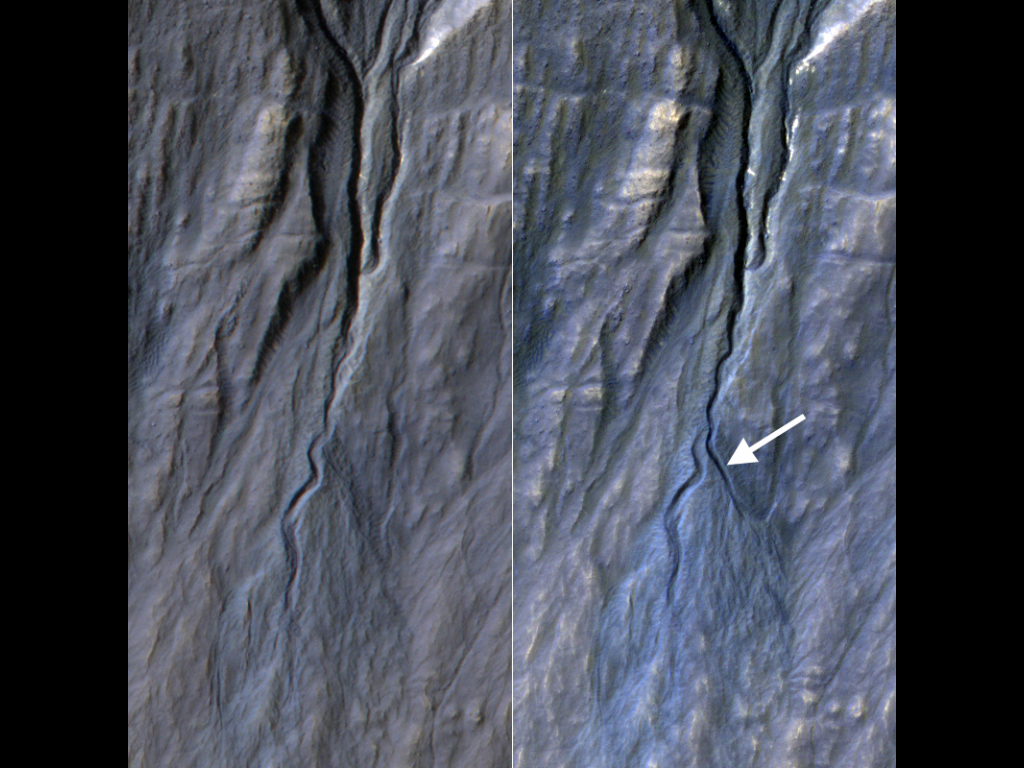
With the orbiter back up and running, a new discovery was made on the Martian surface. Our next image is of that discovery, an all new gully. Taken by the High Resolution Imaging Science Experiment (HiRISE) of the orbiter on two different occasions. The image to the left was taken November 2010 and the image on the right was taken May 2013. The second image reveals the formation of a new gully on the crater wall slope of the southern highlands. It is believed that it was formed by activity by carbon dioxide frost.

.

[caption id="attachment_2638" align="aligncenter" width="630"]New Gully Found on Mars CO2 Ice New Gully Found on Mars CO2 Ice[/caption]

(New Gully Found on Mars CO2 Ice)


.

Switching back to a black/white image, the shot below is of rock rows on striated ground. These rock rows are in the foreground of this image. In the background we can see our, eventual, goal Mount Sharp. The rock rows are in an outcrop called "Junda". Curiosity passed this outcrop during a drive of 328 feet (100 meters) on Feb. 19. 2014.

.

[caption id="attachment_2637" align="aligncenter" width="630"]Martian Landscape With Rock Rows and Mount Sharp Martian Landscape With Rock Rows and Mount Sharp[/caption]

(Martian Landscape With Rock Rows and Mount Sharp)


.

Ahhh, we are getting close to the end of this edition of ‘The Mars Report’ so I am getting to the really good images. Joy! Our next image is one that I have searched for… for many months. Taken with the combination images from the the High Resolution Imaging Science Experiment (HiRISE) camera aboard the Mars Reconnaissance Orbiter Platform, in orbit over the Martian surface. This image shows… … … (drum roll, please!) … the route driven and route planned for NASA's Curiosity Mars rover from before reaching "Dingo Gap". Now, this is a ‘Must Keep’ image for all hardcore Curiosity fans and Martian Fanboys. If I had the money? I would have this puppy enlarged, wall sided, and put it up on a wall in my apartment. Yes, I am a ‘Martian Fanboy’… if you hadn’t already guessed that by the ongoing weekly article series.

.

[caption id="attachment_2635" align="aligncenter" width="630"]Map of Recent and Planned Driving by Curiosity as of Feb. 18, 2014 Map of Recent and Planned Driving by Curiosity as of Feb. 18, 2014[/caption]

(Map of Recent and Planned Driving by Curiosity as of Feb. 18, 2014)


.

Well, My Dear Readers, this brings us to our final image of the day for this edition of ‘The Mars Report’. As I mentioned earlier, depending on available materials next Monday there may or may not be an edition next Monday. I really hope that they get the uploads flying and post lots and lots of images in the next week. The Mast Camera on the rover Curiosity took our final image of the day. This image was taken February 25th, 2014, about a quarter mile out from our next waypoint ‘The Kimberly’. This image shows sandstone layers with varying resistance to erosion are evident in this Martian scene. This is important because so far, on our trip with Curiosity, we have only encountered mudstone formations.

.

This is the why of my hopes that they get the orbiter busy relaying more and more images from this sandstone area. As well, there is a real opportunity for a lot of good science in this area. So, as we bring this edition to an end, enjoy this final image from the Mast Camera of the rover Curiosity.

.

[caption id="attachment_2634" align="aligncenter" width="630"]Differential Erosion at Work on Martian Sandstones Differential Erosion at Work on Martian Sandstones[/caption]

(Differential Erosion at Work on Martian Sandstones)


.


Thank you all for dropping by today and sharing these images. I hope that I have brought a little wonder into your world, today. That is the gift I give to you, My Dear Readers. Wonder.

.

As always I am deeply honored that you come here and read my work.

.

Thank YOU!

.

[caption id="false" align="aligncenter" width="234"]The Other Shoe eBay Store The Other Shoe eBay Store[/caption]


 .


[caption id="attachment_2296" align="aligncenter" width="630"]The Other Shoe's Daniel Hanning The Other Shoe's Daniel Hanning 2/2014[/caption]

Monday, March 24, 2014

The Mars Report - March 24th, 2014

.


[caption id="attachment_2571" align="aligncenter" width="630"]Curiosity Making Headway West of 'Dingo Gap' Curiosity Making Headway West of 'Dingo Gap'[/caption]

(Curiosity Making Headway West of 'Dingo Gap')


[CLICK on ANY image in This Article to See LARGER Version]


.

Welcome back My Dear Readers to The Other Shoe and ‘The Mars Report’ for March 24th, 2014. With the lost airliner in Asia, the turmoil brewing in the Ukraine, it is difficult to pull our eyes away from all this disaster and look to the skies. However, that is exactly what I did today, and what I am asking you MY Dear Readers to do for the next few moments. Actually, it is comforting to think that not all of our human condition is pain and suffering of other humans. Though it occupies little real estate in; newspapers, Television reporting, cable news networks and even blogs.

.

Curiosity, remember, is the Martian rover that we are following here at The Other Shoe. Even though it does not make the news, there is a lot of ‘good science’ happening on the surface of Mars. Hundreds of America; scientists, teachers, students, interns and elder scholars work tirelessly to bring useable science out of the mystery that surrounds our sister planet. Even science from back when I was still in school has relevance today. Take, for example, the image below. This is an image from the Voyager Project back in 1979.

.

[caption id="attachment_2575" align="aligncenter" width="630"]Martian Morning Clouds Seen by Viking Orbiter 1 in 1976 Martian Morning Clouds Seen by Viking Orbiter 1 in 1976[/caption]

(Image of Martian Clouds from Orbit – Voyager 1 1976)


.

The twin Voyager orbiters were the first, and last, manmade research vehicles to ever capture this sight. This is an image of morning clouds over Valles Marineris area of equatorial Mars. Never before, and not since, has any other humans brought back images of this complexity, and splendor. Even thirty-five years ago, American orbital research vehicles brought back scientific discoveries that help us better understand other climates, and ultimately our own. No other nation, on the planet earth, has ever managed to bring back images like this. American still stands as the founding nation of interplanetary flight, and discovery.

.

Now, for something completely different… a recent image from the surface of Mars thanks to the Curiosity rover’s NAVCAM. The navigational camera sits atop the center mast on the rover Curiosity. This image is a composite of several images taken by the NAVCAM on Mars Day 574 dating March 18th, 2014.This image looks southward toward a planned science waypoint at "the Kimberley," with an outcrop of eroded sandstone in the foreground. ‘The Kimberly’ is named after a region of Australia, here on earth. Now, ‘the Kimberly’ on Mars is made up of sandstone formations. This sandstone area in the Kimberly will be new and different terrain than the mudstone Curiosity has been limited to, since landing. This gives Curiosity, and scientists here on earth, a new opportunity to study sandstone formations on a foreign planet.

.

[caption id="attachment_2577" align="aligncenter" width="630"]Panoramic of Sandstone Outcrop Near 'The Kimberley' Waypoint Panoramic of Sandstone Outcrop Near 'The Kimberley' Waypoint[/caption]

(Panoramic of Sandstone Outcrop Near 'The Kimberley' Waypoint)


.

For our next image, we go back into orbit over the Martian surface. The image, below, was taken by The High Resolution Imaging Science Experiment (HiRISE) camera on NASA's Mars Reconnaissance Orbiter. The Mars Reconnaissance Orbiter was launched prior to Curiosity and is meant as a navigational and support vehicle for the Curiosity rover. Well, let me clarify just a bit there. This orbiter does have its very own missions. However, it does help provide navigation for Curiosity, tracks Curiosity’s movement, and high resolution images from this orbiter are regularly used to help map out Curiosity’s movements and to plot its overall course. It was launched in conjunction with Curiosity and is immeasurably helpful to the Curiosity rover’s missions. The image below shows the rover Curiosity on ‘Murray Ridge’ on the Martian surface.

.

[caption id="attachment_2570" align="aligncenter" width="630"]Curiosity From Space Murray Gap Curiosity From Space Murray Gap[/caption]

(Curiosity from Space on Murray Ridge approaching Murray Gap)


.

Staying in orbit, for the time being, our next image is still from the HiRISE camera. This is a very unique image, even for one from the Martian surface. As we approach the spring on the northern continent of Mars, we begin to see Martian sand dunes appear. They appear as they surface from their winter cover of seasonal carbon dioxide (dry) ice. Well… I tried to phrase this different... I could not. So, here is a quote from the NASA web site.

.

        “The steep lee sides of the dunes are also ice-free along the crest, allowing sand to slide down the dune. Dark splotches are places where ice cracked earlier in spring, releasing sand. Soon the dunes will be completely bare and all signs of spring activity will be gone.”[1]

.

[caption id="attachment_2576" align="aligncenter" width="630"]Martian Sand Dunes in the Spring Martian Sand Dunes in the Spring[/caption]

(Martian Sand Dunes in the Spring)


.

Well now, My Dear Readers, I had planned to share three or four more images. Had it all planned out, saved to my hard drive and ready to upload to both blogs. Going to be a smashing good issue of ‘The Mars report’ for its return to The Other Shoe. Apologies all around, as my pains (the severe sharp pain in my cervical spine, the lovely shooting pains form my cervical down my left arm and all the way into my left hand, and the very entertaining pains into my face and checks… that often make my left eye do the oddest things… even messes with the vision in my left eye)… yes, those pains… are really kicking up. Thus, resulting in a growing severe headache and accompanying irritability. Apologies, that I must include and narrate this final image. I hope for improved health… it never comes. Again, my apologies for this issue being shorter than planned.

.

The image below… YES, it does look like ‘communicator badges’ from ‘Star Trek’! However, they are sand dunes. Again, staying in orbit to the very end, this image was taken by the HiRISE camera aboard NASA's Mars Reconnaissance Orbiter on Dec. 30, 2013.

.

[caption id="attachment_2574" align="aligncenter" width="630"]Martian Dunes Flying in Formation Martian Dunes Flying in Formation[/caption]

(Martian Dunes Flying in Formation)


.

Well… one more image. The image below is from the Mastcam back aboard the rover, Curiosity. This image is a scene looking back at where Curiosity crossed a dune at "Dingo Gap" combines several exposures taken by the Navigation Camera (Navcam) high on the rover's mast.  The panorama is centered toward the east and spans about 225 degrees, from north-northwest at the left to west-southwest at the right..

.

[caption id="attachment_2578" align="aligncenter" width="630"]Panoramic view Backwards at Dingo Gap Panoramic view Backwards at Dingo Gap[/caption]

(Panoramic view Backwards at 'Dingo Gap')


.

That brings us to the end of this edition of ‘The Mars Report’ for March 24th, 2014. My Dear Readers, I want you to know and understand that bringing these images to you brings me great pleasure. All my life I have looked upward to the stars. Filled with boyhood wonder, even at 55, I have looked at the moon and stars. All my life I have wanted nothing more than to slip the surly bounds of earth and set foot on another planet. It is my humble opinion that earth… is/was meant merely as mankind’s cradle. That like our young, we are meant to leave the crib and walk elsewhere. Mankind simply cannot stay on earth. For those in-the-know you understand that, one day, our sun will explode. At that time, all life left on earth shall perish. Period.

.

As always I am deeply honored that you come here and read my work.

.

[caption id="attachment_2573" align="aligncenter" width="630"]Earth as Seen From Nightitme Martian Surface Earth as Seen From Nightitme Martian Surface[/caption]

(Earth as Seen From Nightitme Martian Surface)


.

Thank YOU!

.


[1] http://www.nasa.gov/content/martian-sand-dunes-in-spring/#.UzCnUahdX85